

Washers in Every Material: Aluminum, Brass, Steel, Stainless & Non-Metallic
Willie Washer stamps and machines flat washers in more than 30 materials, with over 60,000 items in stock for same-day shipping and an 8-million-pound raw-material inventory to support custom runs. The sections below describe each material family and its most common applications.
Quick Material Comparison
| Material | Strength | Corrosion Resistance | Conductivity | Typical Use |
| Low Carbon Steel | Moderate | Low without Plating | Moderate | General Fastening, Highest Volume |
| Alloy/Case-Hardened Steel | High | Low without Plating | Moderate | High Clamp Load, Structural Joints |
| Spring Steel | High, Resilient | Low without Plating | Moderate | Belleville and Wave Washers |
| Stainless 300 Series | Moderate | High | Low | Food, Medical, Outdoor |
| Stainless 316 | Moderate | Very High in Chlorides | Low | Marine, Chemical Processing |
| Stainless 400 Series | High, Hardenable | Moderate | Low | Valve and Pump Hardware |
| 17-4PH/17-7PH | Very High | High | Low | Aerospace, Loaded Springs |
| Brass | Low to Moderate | High | High | Electrical, Plumbing, Terminals |
| Bronze | Moderate | High | High | Bearing and Wear Surfaces |
| Copper | Low | High | Very High | Grounding, Sealing, Heat Transfer |
| Aluminum | Low to Moderate | Moderate, Oxide Layer | High | Weight-Critical Assemblies |
| Titanium | Very High per Weight | Very High | Low | Aerospace, Medical Implants |
| Inconel/Monel | High at Temperature | Very High | Low | Heat, Seawater, Acids |
| Non-Metallic | Varies by Polymer | Depends on Chemistry | Insulating | Isolation, Samping, Surface Protection |
Low Carbon Steel Washers
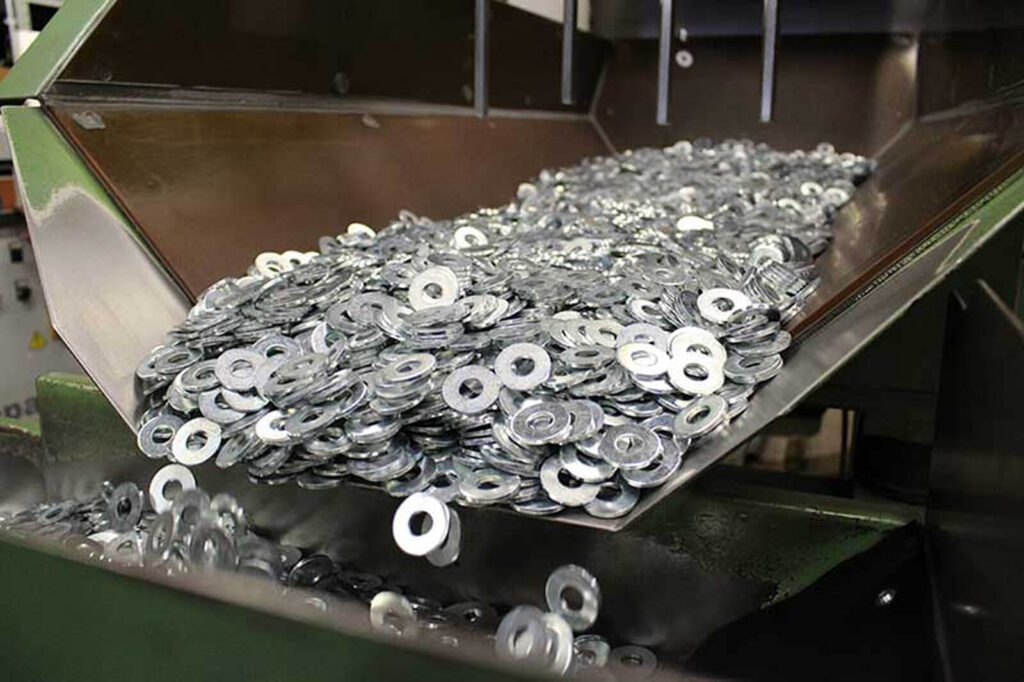
Low carbon steel accounts for the largest share of industrial fastening. Low carbon steel washers span an oversized hole, distribute the clamp load across a wider bearing area, prevent the nut face from embedding into softer material, and maintain close thickness tolerance in high-volume production. It costs less per piece than any other material we stock.
Uncoated low carbon steel provides minimal corrosion resistance, so protection comes from the finish: zinc, phosphate and oil, black oxide, or hot-dip galvanizing for outdoor service. Case-hardened low carbon steel provides a hard surface over a ductile core, which is appropriate for joints that are repeatedly assembled and disassembled.
Hardened and Alloy Steel Washers
At higher clamp loads, a soft steel washer will dish, and the joint will lose preload. Alloy steel and hardened alloy steel retain their geometry under high tension, which is why structural and hardened washer specifications call for them.
Spring steel serves a different function. Instead of resisting deflection, it stores and returns it, which is the operating principle of the Belleville and conical washers, along with wave spring washers that maintain tension through thermal cycling and vibration.
Stainless Steel Washers
Stainless steel is specified when the assembly is exposed to moisture, chemicals, or wash-down cleaning. Grade determines performance more than the category does:
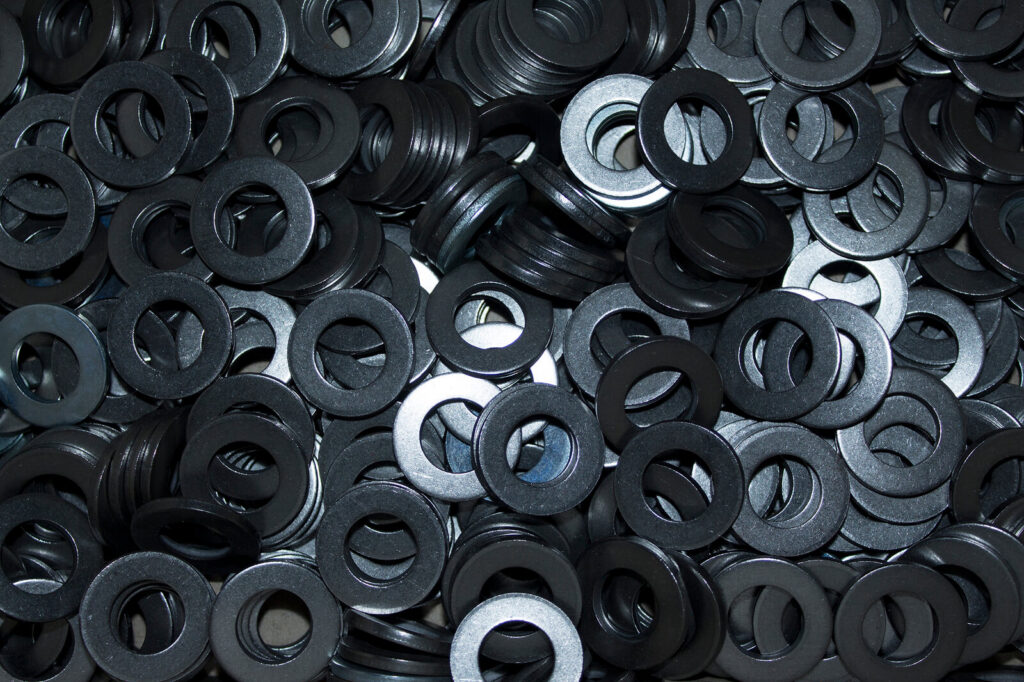
- 300 series provides general corrosion resistance for most applications. It’s non-magnetic, weldable, and commonly specified for outdoor, food processing, and medical assemblies.
- 316 series contains molybdenum, which substantially improves resistance to chlorides and salt water compared with 304. Marine hardware and chemical processing equipment specify it for that reason.
- 400 series can be heat-treated to higher hardness and is magnetic. It trades some corrosion resistance for strength in valve and pump hardware.
- 17-4PH and 17-7PH are precipitation-hardening grades that reach high strength while retaining corrosion resistance. 17-7PH is commonly specified for loaded spring washers in aerospace applications.
Any stainless steel washer we produce can be supplied passivated to remove free iron from the surface and restore the passive layer after forming.
Brass, Bronze, Copper, and Nickel Silver Washers
Copper alloys are selected primarily for electrical and thermal conductivity.
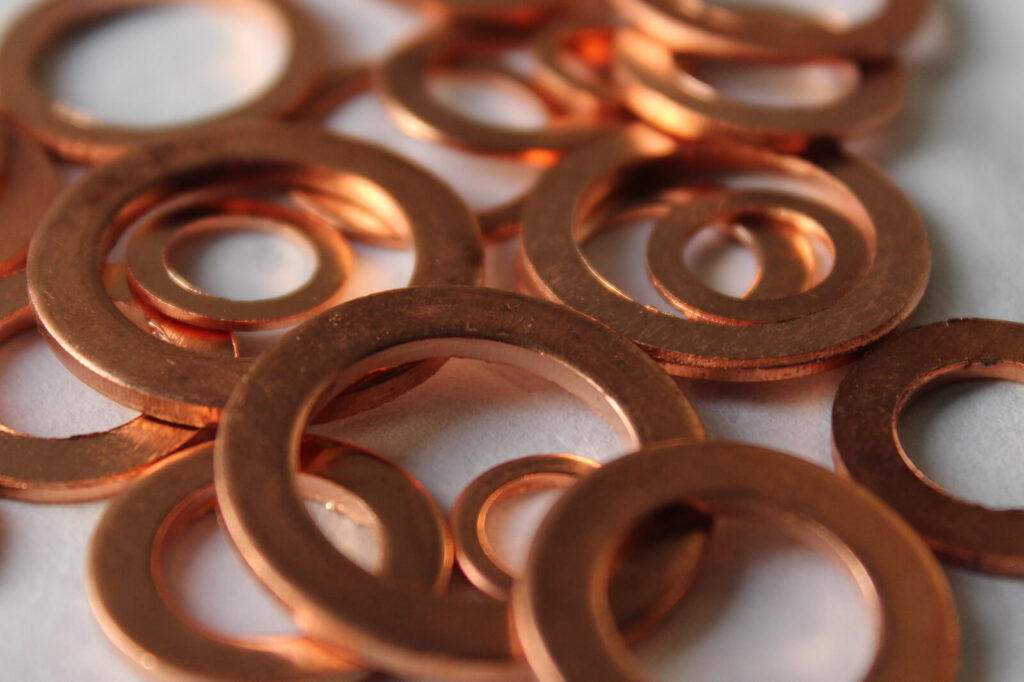
- Brass washers conduct current and resist corrosion without plating, which is why they’re standard on grounding lugs, terminal blocks, and plumbing fittings.
- Bronze washers perform well on bearing and wear surfaces with sliding contact.
- Copper washers offer the highest conductivity and the softest bearing face, which allows them to conform and seal.
- Nickel silver washers provide a harder, brighter surface for decorative and electrical applications.
Aluminum Washers
Aluminum washers are specified to reduce assembly weight. Aerospace, automotive, and portable equipment designs carry significant penalties for added mass, and aluminum reduces it substantially compared with steel at equivalent dimensions. The natural oxide layer provides baseline corrosion resistance, and anodizing thickens that layer while allowing color coding.
One design consideration applies: aluminum is anodic to steel and stainless, so pairing them in a wet assembly accelerates corrosion of the aluminum. Match the washer material to the surrounding structure, or isolate it with a non-metallic washer.
Non-Metallic Washers
Non-metal washers meet requirements that metal can’t. Our catalog includes:
- Nylon and acetal are general-purpose options for a non-metallic flat washer. Both insulate electrically, resist most solvents, and protect finished surfaces from marring.
- PTFE withstands the widest temperature range and the most aggressive chemical exposure, with very low friction.
- Phenolic retains structural strength at higher temperatures than most polymers and is electrically insulating.
- Polyurethane washers absorb shock and return to their original shape, making them appropriate for vibration and impact damping.
- Fiber and rubber seal against fluid where a metal bearing face would leak.
- Nylatron contains molybdenum disulfide for bearing and wear applications.
Filter our full inventory of non-metallic flat washers by material, diameter, and thickness to locate a stocked part.
High-Performance Alloys
For high-temperature, seawater, and aggressive chemical service, we stock and produce Inconel, Monel, and titanium.
Inconel retains strength at temperatures that would anneal stainless steel. Monel resists seawater and the acids that attack most stainless grades. Titanium offers the highest strength-to-weight ratio among the metals we stock, along with the biocompatibility required by medical and aerospace programs.
These alloys are also available in special washers and stampings produced to customer prints.
Get a Quote for Washers in Your Material
Send us the print, the operating environment, or a sample part. We have specified washers for aerospace, defense, agriculture, energy, and marine programs for more than 50 years. Every part ships from our Elk Grove Village plant under ISO 9001:2015 with full traceability from raw material to finished piece.
Browse flat washers by material and finish, or request a quote, and we will work through the options with you.
Frequently Asked Questions About Our Washer Materials
Can you make washers in a material not listed?
Yes. We work from customer prints and specifications and source raw stock to meet the requirements, including specialty alloys and non-standard polymers. Request a quote with your specification.
When should I use a non-metallic or polyurethane washer instead of a metal washer?
Non-metallic washers make sense when the part needs to resist oil, water, or solvents, withstand a specific temperature range, or flex slightly rather than remain rigid. Polyurethane washers specifically add abrasion resistance and more give than a rigid plastic, which is useful in applications with vibration or repeated contact.
What is the most common washer material?
Low carbon steel with a zinc plating. It’s suitable for most general fastening at the lowest cost per piece. Stainless steel is the next most common, specified when corrosion resistance is required.